Florida HVAC Guide
Water-Cooled Air Conditioning: A Florida Buyer’s Guide
Water-based cooling systems are common in some condominiums and larger buildings. Buyers should understand which components serve the individual unit, which belong to the association, and where maintenance responsibility changes.
“Water-cooled AC” can describe several arrangements. A large building may use a central chilled-water plant, a condenser-water loop with individual water-source heat pumps, or packaged equipment connected to a cooling tower. These systems do not all operate or divide ownership the same way.
How Water-Based Cooling Works
All air-conditioning systems move heat from indoors to another location. In a conventional split system, refrigerant carries heat to an outdoor air-cooled condenser. In a water-based building system, water may carry heat between equipment and a central plant or cooling tower.
The room air still passes across a cold coil and loses heat and moisture. The difference is how the system ultimately rejects that heat.
Common System Types
Central chilled-water system
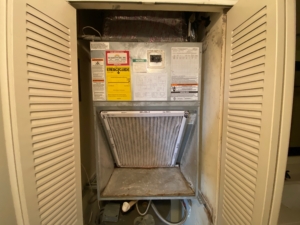
A central plant chills water and pumps it through the building to air handlers or fan-coil units. The individual unit may contain a fan, filter, control valve, condensate pan, and drain while the association or building operator maintains the central equipment.
Water-source heat pump
An individual heat pump exchanges heat with a shared water loop. The unit owner may be responsible for the in-unit heat pump while pumps, boilers, cooling towers, and loop piping may be common elements.
Water-cooled packaged equipment
Some installations combine components in a cabinet connected to building water piping. Access, drainage, noise, and replacement constraints can differ from a typical outdoor-condensing-unit arrangement.
Potential Advantages
- No individual outdoor condenser may be needed at the residence.
- Centralized heat rejection can suit dense or high-rise buildings.
- Exterior noise and equipment exposure may be reduced.
- Shared systems may allow professional building-wide operation and maintenance.
These are design possibilities, not guaranteed savings. Actual efficiency and cost depend on equipment age, controls, water treatment, maintenance, utility structure, and how expenses are allocated.
Common Concerns
- Condensate pan or drain leakage.
- Corrosion at valves, coils, piping, or cabinet components.
- Damaged insulation and sweating pipes.
- Dirty filters, coils, or blower components.
- Valve, pump, thermostat, or control failures.
- Water treatment, scaling, or biological growth in shared systems.
- Noise or vibration from in-unit equipment.
- Limited replacement options because of cabinet size, piping, or association requirements.
Questions Condo Buyers Should Ask
- What type of HVAC system serves the unit?
- Which equipment belongs to the unit owner and which is a common element?
- Who maintains valves, condensate piping, water-loop piping, and central equipment?
- Are cooling costs included in association fees or individually metered?
- Are there recent service records, reserve studies, or planned system projects?
- Does replacement require an approved contractor or specific equipment?
- Are there recurring complaints about humidity, leaks, noise, or seasonal shutdowns?
Maintenance Responsibilities
In-unit filters, drains, pans, coils, blowers, controls, and accessible piping may require routine attention. Shared cooling towers, pumps, heat exchangers, and water treatment require specialized building maintenance. Responsibility should be confirmed in association documents rather than assumed from equipment location.
What a Home Inspector Checks
During a buyer home inspection, the inspector operates accessible normal controls under suitable conditions and observes visible in-unit HVAC components, condensate provisions, piping, insulation, leakage, corrosion, and apparent response. Central plants, cooling towers, concealed piping, association records, and engineering performance are outside a typical unit inspection.
Buyers may need HVAC service records, association documentation, and specialist evaluation to understand remaining life and shared-system condition.
Frequently Asked Questions
Is water-cooled AC always more efficient?
No. Efficiency depends on the complete system, controls, maintenance, climate, operating schedule, and allocation of pumping and cooling-tower energy.
Does the unit owner replace the air conditioner?
It depends on the condominium documents and system design. In-unit equipment may be owner responsibility even when it connects to a shared loop.
Can a home inspector inspect the cooling tower?
A standard inspection of an individual residence generally does not include central mechanical plants or association-owned equipment.
Schedule a South Florida Home Inspection
GGR Home Inspections evaluates accessible HVAC components within the inspected property. Call 305-908-7050 or schedule online.